Fat-tailed distributions
Distributions that give extreme outcomes more weight than a normal model.
Library note. Check the assumptions and further reading before applying a formula.
What Is This?
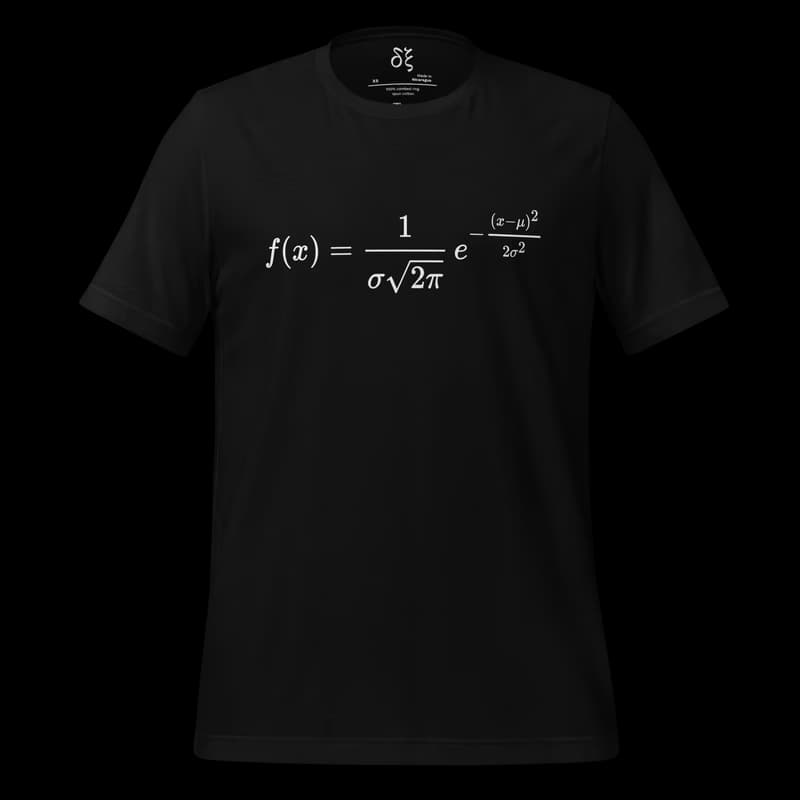
A normal model makes very large departures from its centre extremely rare. Many datasets produce those departures more often. Such tails matter because a few observations can dominate a loss estimate or an average. A bell-shaped centre is not enough to establish normal tails. Inspect the extremes and the assumptions behind the statistic you plan to use.
Try an example
The Cauchy distribution has a central peak that looks fairly ordinary. You might expect more data to make its average settle down. Yet the sample mean does not settle around a fixed value, even with more independent draws. The distribution has no finite mean.
Where it needs care
Not every fat-tailed distribution has infinite variance. Tail shape is difficult to estimate, especially from short samples. Do not assume a particular tail law just because one large outlier occurred.
Historical Context
Augustin-Louis Cauchy studied the distribution now bearing his name. Benoît Mandelbrot later drew attention to heavy-tailed models of financial price changes.
Real-World Applications
- Stress-test losses beyond a Gaussian baseline.
- Choose robust summaries when extremes dominate ordinary averages.